Sunday, November 29, 2026
When Competence Isn't Enough
five reasons capable leaders get stuck
When the beliefs that built your life become the very things keeping you from moving forward.
Sometimes the obstacle isn't your capacity. It's your theology.
When Doing Everything Right Isn't Enough
More than a decade ago, I hit a wall.
Not the proverbial kind. A full-blown nervous breakdown.
I was a Bible-believing woman. A leader. A driver. A doer.
I tithed. I journaled. I prayed. I served. I did everything a good Christian woman was supposed to do.
And suddenly, I could barely function.
Every day felt like walking through waist-high mud with no end in sight. No book, conference, prayer formula, or deliverance session seemed capable of getting me out of it.
I wasn't simply exhausted. Something much deeper had fractured.
What I eventually discovered challenged nearly everything I had been taught about God, suffering, identity, and personal responsibility.
Because sometimes, the very belief systems we've built our lives upon are the ones keeping us stuck.
01 | You've Mistaken God for the Author of Your Pain
Somewhere along the way, Christianity developed an extraordinary talent for making God sound like the antagonist in His own redemption story.
We say things like:
“God is allowing this to teach me something.”
“He must have closed that door for a reason.”
“Maybe He's breaking me so He can use me.”
And then we wonder why we struggle to trust Him.
God's ability to redeem suffering does not establish Him as its author. His ability to teach us through adversity does not mean He engineered the adversity for our education.
God doesn't send shipwrecks just to rescue you from them.
There is a fundamental difference between believing God is working within your circumstances and believing He orchestrated your devastation.
It's extraordinarily difficult to run toward the One you secretly believe you need protection from.
02 | You've Confused Accountability with Authority
People fail us. Institutions disappoint us. Systems malfunction. Sometimes the people entrusted with our well-being become the very people who compromise it.
Acknowledging that reality is not bitterness. It's discernment.
But holding someone accountable for what they did is different from granting them authority over what happens next.
In Matthew 13, Jesus describes a field in which an enemy has sown weeds among the wheat. Rather than risk destroying the wheat in an attempt to eradicate every weed, the instruction is to allow the wheat to continue growing until harvest.
There is something profoundly instructive about that.
Not every injustice must be resolved before something good can grow again.
Healing may require boundaries, grief, accountability, and professional support. But it does not require the cooperation of everyone who contributed to your pain.
They may be responsible for what happened. They do not have to remain the governing authority over what becomes of you.
03 | Your Identity Hasn't Caught Up with Your Capacity
Capable leaders are remarkably good at developing competence.
Identity, however, is another matter entirely.
You can develop the skills to occupy a position your internal beliefs won't allow you to inhabit comfortably.
You can earn the title, build the business, lead the organization, and still feel compelled to prove you deserve to be there.
I often describe this as an internal thermostat.
If your established sense of identity is set at 65 degrees and your circumstances suddenly invite you to operate at 75, the unfamiliarity can feel threatening—even when the opportunity is precisely what you've been working toward.
You may find yourself overworking, shrinking, second-guessing, or retreating into familiar patterns.
Not because you're incapable, but because competence and identity don't always develop at the same rate.
Sometimes what we interpret as a closed door is actually an invitation to examine the beliefs we carry through it.
04 | You've Made Hope Contingent on Your Circumstances
Hope deferred makes the heart sick.
And after enough disappointment, hope itself can begin to feel irresponsible.
We stop anticipating good things. We temper our expectations. We call it realism when, in fact, we may be protecting ourselves from another devastating loss.
Eventually, we decide we'll allow ourselves to experience joy, peace, or expectation once our circumstances improve.
But hope is not the denial of reality.
It is the refusal to grant present reality exclusive authority over what you believe is possible.
This isn't about manufacturing positivity, pretending grief doesn't exist, or speaking enough affirmations to make life cooperate.
It's about recognizing that disappointment does not possess prophetic authority.
What has happened is not necessarily an indication of what will happen.
You don't have to wait for the evidence of a different future before allowing yourself to believe one is possible.
05 | You're Operating from a Broken Heart
This may be the most consequential—and least understood—of all five reasons.
We tend to associate brokenheartedness with romantic loss. But a heart can fracture under the accumulated weight of betrayal, deferred hope, disillusionment, religious confusion, and repeated disappointment.
For accomplished leaders, brokenheartedness can be especially difficult to recognize because competence often disguises it.
Sometimes it looks like extraordinary productivity.
Sometimes it looks like exceptional leadership.
Not every highly functioning leader is a healthy leader. Sometimes what an organization celebrates as exceptional performance is actually a person's most sophisticated coping mechanism.
Chronic overfunctioning. Emotional exhaustion. Hypervigilance. An inability to rest. A diminished capacity for joy. The relentless need to remain useful.
Some of these experiences also overlap with burnout, depression, and trauma-related conditions. They deserve serious attention, not another spiritual assignment.
Isaiah 61 speaks of binding up the brokenhearted.
Notice that the language is restorative, not disciplinary.
A broken heart doesn't need another performance standard.
It needs restoration.
Perhaps the most devastating thing religious conditioning can do is convince people that their significance must be established through their usefulness to God.
There is a fundamental difference between living to establish your significance and living from your significance.
You were never intended to spend your life auditioning for an identity that was already yours.
What If You Don't Need Another Breakthrough?
What if the next chapter of your life requires something other than more discipline, more striving, more spiritual warfare, or another exhausting attempt to prove your faith?
What if it requires examining the beliefs that have governed your understanding of God, yourself, and your assignment?
Beliefs cannot eliminate every obstacle. They cannot undo every injustice. And they are not a substitute for medical care, counseling, or practical intervention.
But they profoundly influence how we interpret our experiences and what we believe is possible beyond them.
I didn't need another religious formula.
I needed a more accurate understanding of the God I loved and the woman He had created me to be.
Perhaps you do, too.
CONTINUE THE CONVERSATION
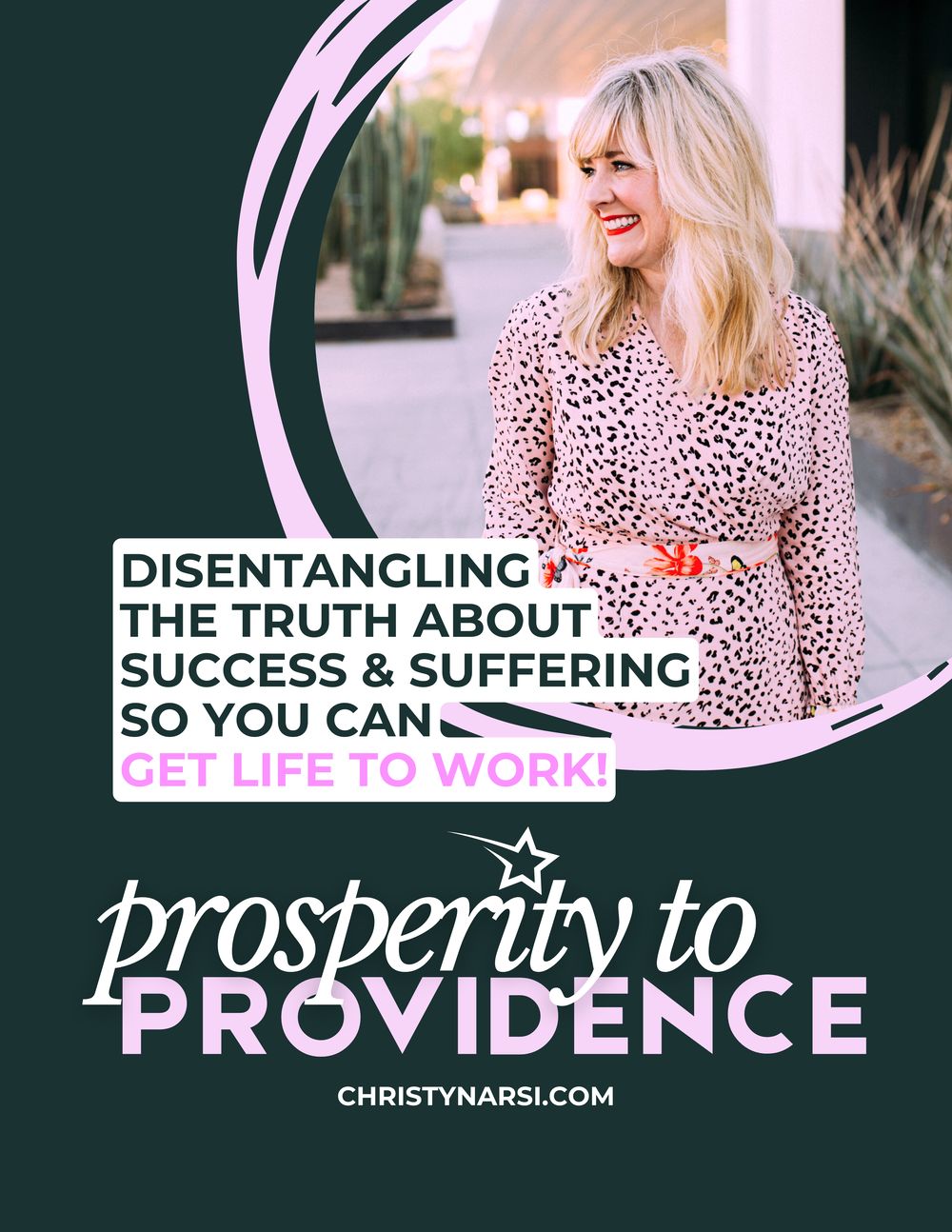
from prosperity to providence
I wrote the book I wish someone had handed me during my breakdown.
Challenge the religious assumptions that distort your understanding of God, suffering, and identity.
don't echo. take ground.

Copyright © 2026 Christy Narsi. All rights reserved
© 2026 Christy Narsi. All rights reserved.